Book available on Amazon: Link ……..https://amzn.in/d/2bUvej0

Difference between a "Completion certificate" and an "Occupancy certificate"?
To, Date: 10-12-2025
The Chairman,
Karnataka Real Estate Regulatory Authority,
Bangalore, Karnataka
Respected Sir,
In furtherance to the letter reference No.-K-RERA/C-PS/39/2025-2026 issued dated on: 30-10-2025, humbly submit that the context of the letter regarding uniformity and clarity about the occupancy certificate in both the RERA and Municipal Acts has been misunderstood and misinterpreted. The terms "occupancy certificate" and "completion certificate" have been overlooked and considered similar in nature. Unfortunately, both in practice and from a legal perspective, as per the Acts enacted to regulate the real estate and construction industry through various local, state, and central laws, the situation remains the same across India.
Hereby, would like to share our views on specific types of real estate projects and the stages of their construction. Construction typically involves three main stages: pre-construction, during construction, and post-construction. Although there are many types of building uses in the construction industry, here we will focus primarily on RERA-related real estate projects, specifically residential and commercial developments.
When we refer to the rulebooks—such as KTCP Act-1961, K-DCR-2016-17 (Building By-laws), NBC-2006, NBC-2016, GBA Act, BBMP Act, KMC Act, KM Act, RERA-2016, and RERA Rules-2017—we find big gap in explanations regarding the “completion certificate” and “occupancy certificate”.
Somehow, it places more emphasis on building or layout approval, making owners or builders primarily responsible and accountable.
Moreover, entry for builders to start a project during pre-construction is made complex by the need to obtain multiple permissions and approvals from various departments with jurisdiction. In contrast, exiting the project post-construction is allowed through external technical empanelled professionals registered with development authorities. These professionals are responsible for verifying and certifying the project's status and submitting a report to the planning authority to grant a “completion or occupancy” certificate.
These legal conditions focus less on the real estate project's perspective of "completion or occupation."
It is up to each individual to interpret and form their own opinion. Here, would like to share our opinion of the letter.
Clarity is of utmost importance and is urgently needed for homebuyers who are disadvantaged, deceived, and cheated, while builders gain undue advantages.
On the other hand, to resolve this issue, it is important to clarify the distinction between the concepts of “Completion Certificate” and “Occupation Certificate” permissions in the eyes of the law and the public, rather than treating them as the same and merging them together.
Both documents are important not only for registration, but also for re-registration (extension), de-registration, non-registration, and obtaining a warranty for a real estate project under the RERA Act and Rules.
According to the Building by-laws, there are over 100+ types of buildings, making it impossible to create specific start-to-end by-laws for each building typology. To address this, a set of guidelines called the National Building Code has been released, serving as a standard for the construction industry. Every state and local authority enacts laws to plan construction and establish state building by-laws and rules to follow.
To understand the difference between a “Completion Certificate” and an “Occupation Certificate,” we need to clearly know the definition of each term as provided in the RERA Act, since it governs our decision.
For example, in RERA, 'Apartment' is defined to include multiple types of buildings such as:
Section 2((e)- “apartment” whether called block, chamber, dwelling unit, flat, office, showroom, shop, godown, premises, suit, tenement, unit or by any other name, means a separate and self-contained part of any immovable property, including one or more rooms or enclosed spaces, located on one or more floors or any part thereof, in a building or on a plot of land, used or intended to be used for any residential or commercial use such as residence, office, shop, showroom or godown or for carrying on any business, occupation, profession or trade, or for any other type of use ancillary to the purpose specified;
The terms “completion certificate” and “occupancy certificate” used interchangeably are not by chance but with intentional distinction. They do not have the same meaning and should never be used as the same term in the real estate sector. The completion term refers to finishing the project, while the occupancy term applies to occupying the building with only basic habitable services such as water, sanitation, and electricity.
Section 2(j)- “building” includes any structure or erection or part of a structure or erection which is intended to be used for residential, commercial or for the purpose of any business, occupation, profession or trade, or for any other related purposes;
The most excluded, undiscussed, overlooked, neglected, ignored, and unconsidered part of the “Occupancy Certificate” is the common area, which is repeatedly mentioned in RERA across several sections whenever possession is handed over to the allottee, association of allottees, or competent authority. These amenities and facilities play a crucial role in any real estate project and serve as a key selling point for promoters to attract homebuyers.
Section 2(n)- “Common areas” mean—
(i) the entire land for the real estate project or where the project is developed in phases and registration under this Act is sought for a phase, the entire land for that phase;
(ii) the stair cases, lifts, staircase and lift lobbies, fire escapes, and common entrances and exits of buildings;
(iii) the common basements, terraces, parks, play areas, open parking areas and common storage spaces;
(iv) the premises for the lodging of persons employed for the management of the property including accommodation for watch and ward staffs or for the lodging of community service personnel;
(v) installations of central services such as electricity, gas, water and sanitation, air-conditioning and incinerating, system for water conservation and renewable energy;
(vi) the water tanks, sumps, motors, fans, compressors, ducts and all apparatus connected with installations for common use;
(vii) all community and commercial facilities as provided in the real estate project;
(viii) all other portion of the project necessary or convenient for its maintenance, safety, etc., and in common use;
Section 2(t)- “development works” means the external development works and internal development works on immovable property;
Section 2(w)- “external development works” includes roads and road systems landscaping, water supply, sewerage and drainage systems, electricity supply transformer, sub-station, solid waste management and disposal or any other work which may have to be executed in the periphery of, or outside, a project for its benefit, as may be provided under the local laws;
Section 2(zb)- “internal development works” means roads, footpaths, water supply, sewers, drains, parks, tree planting, street lighting, provision for community buildings and for treatment and disposal of sewage and sullage water, solid waste management and disposal, water conservation, energy management, fire protection and fire safety requirements, social infrastructure such as education health and other public amenities or any other work in a project for its benefit, as per sanctioned plans;
Section 2(zh)- “planning area” means a planning area or a development area or a local planning area or a regional development plan area, by whatever name called, or any other area specified as such by the appropriate Government or any competent authority and includes any area designated by the appropriate Government or the competent authority to be a planning area for future planned development, under the law relating to Town and Country Planning for the time being in force and as revised from time to time;
Section 2(zj)- “project” means the real estate project as defined in clause (zn);
Section 2(zn)- “real estate project” means the development of a building or a building consisting of apartments, or converting an existing building or a part thereof into apartments, or the development of land into plots or apartments, as the case may be, for the purpose of selling all or some of the said apartments or plots or building, as the case may be, and includes the common areas, the development works, all improvements and structures thereon, and all easement, rights and appurtenances belonging thereto;
Section 2(zq)- “sanctioned plan” means the site plan, building plan, service plan, parking and circulation plan, landscape plan, layout plan, zoning plan and such other plan and includes structural designs, if applicable, permissions such as environment permission and such other permissions, which are approved by the competent authority prior to start of a real estate project;
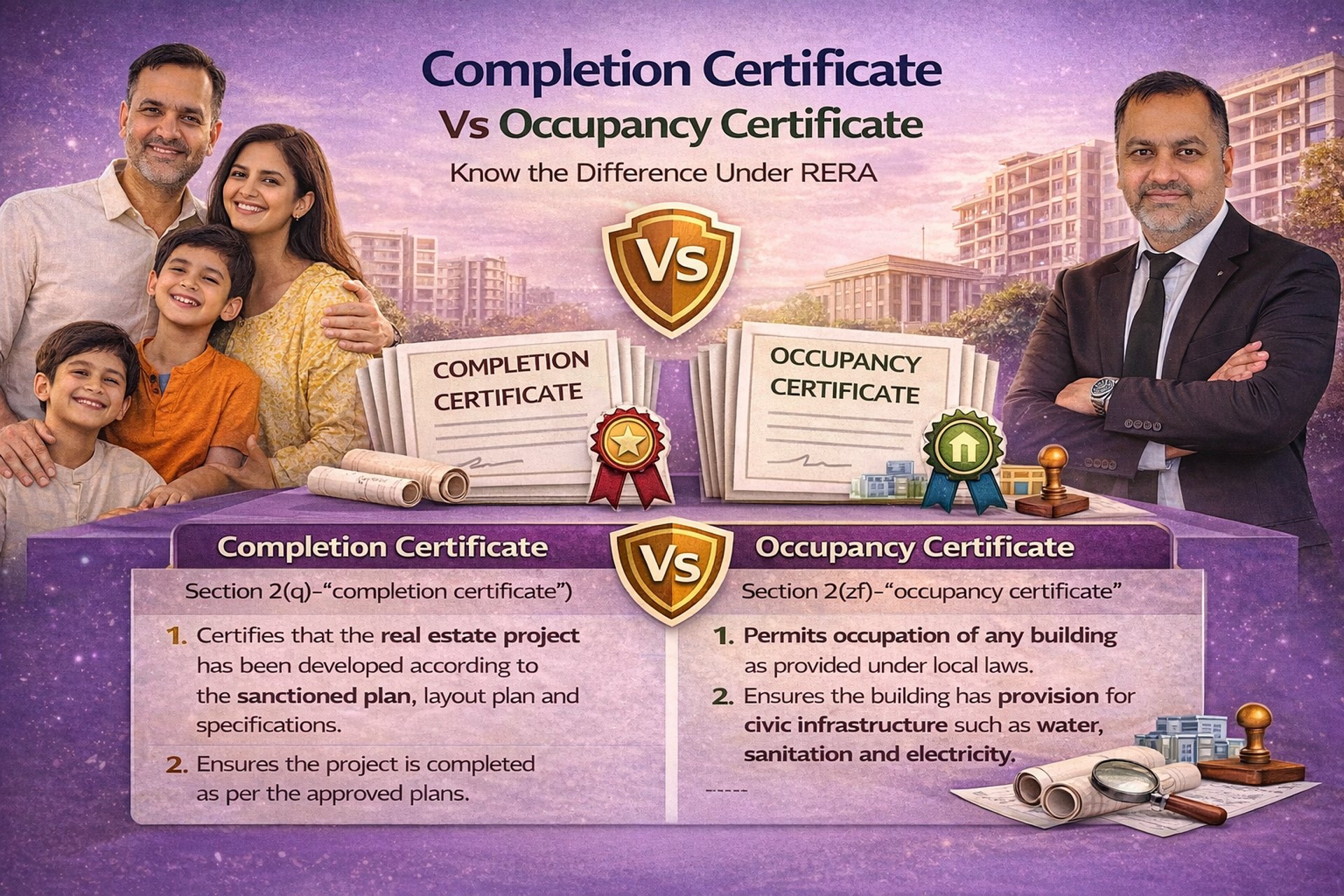
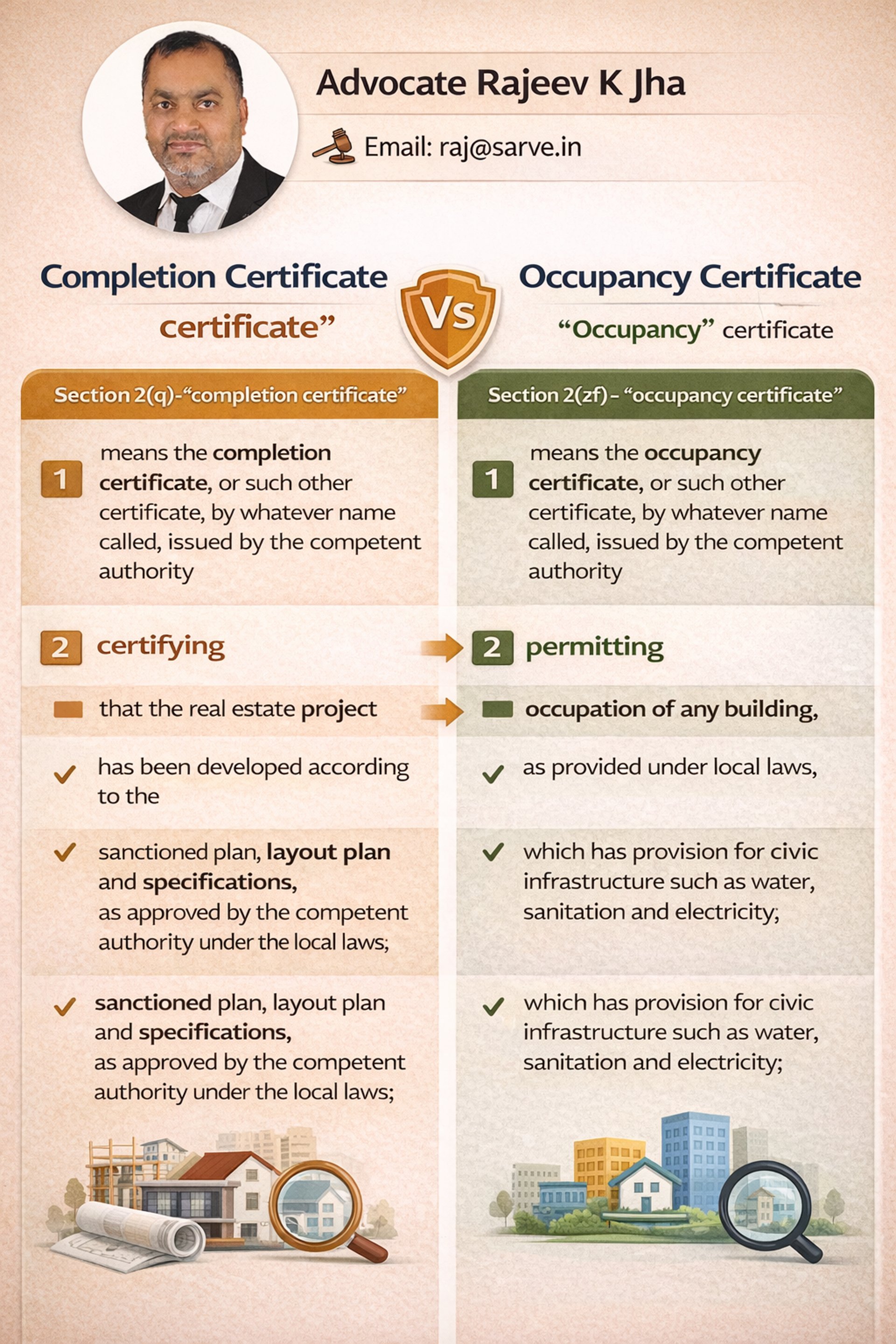
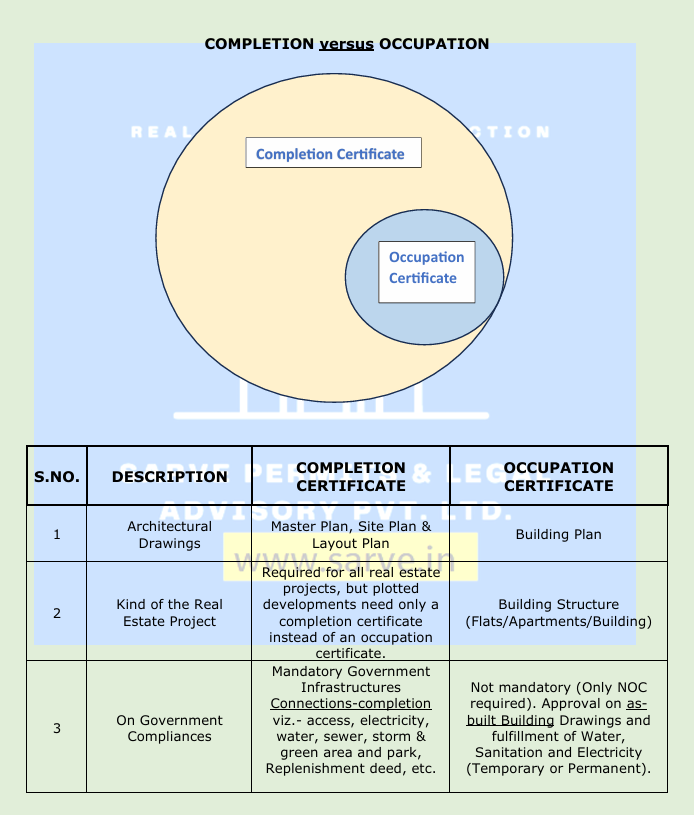
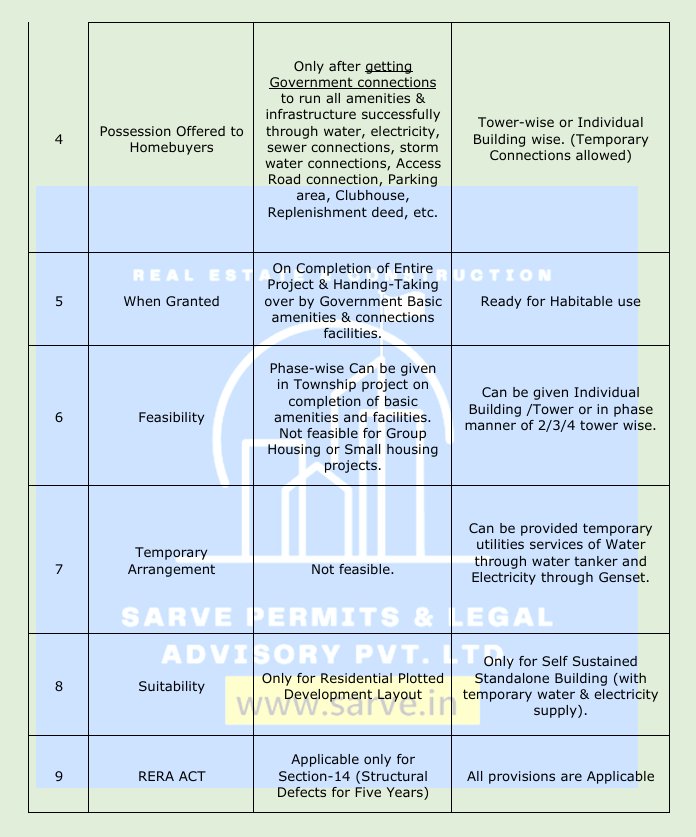
With reference to the letter and the RERA definition, the terms “Completion Certificate” and “Occupation Certificate” are dissected in tabular form to highlight their differences.
Section 2(q)- “completion certificate” means the completion certificate, or such other certificate, by whatever name called, issued by the competent authority certifying that the real estate project has been developed according to the sanctioned plan, layout plan and specifications, as approved by the competent authority under the local laws;
Section 2(zf)- “occupancy certificate” means the occupancy certificate, or such other certificate, by whatever name called, issued by the competent authority permitting occupation of any building, as provided under local laws, which has provision for civic infrastructure such as water, sanitation and electricity;
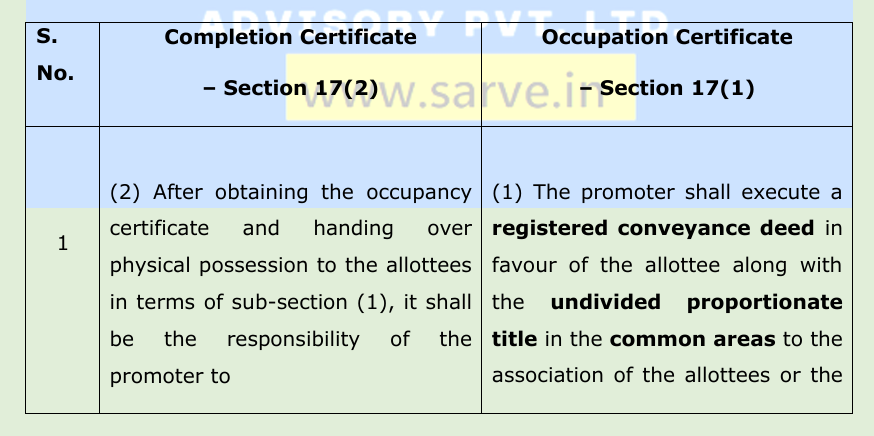
Section 17 Transfer of title.—
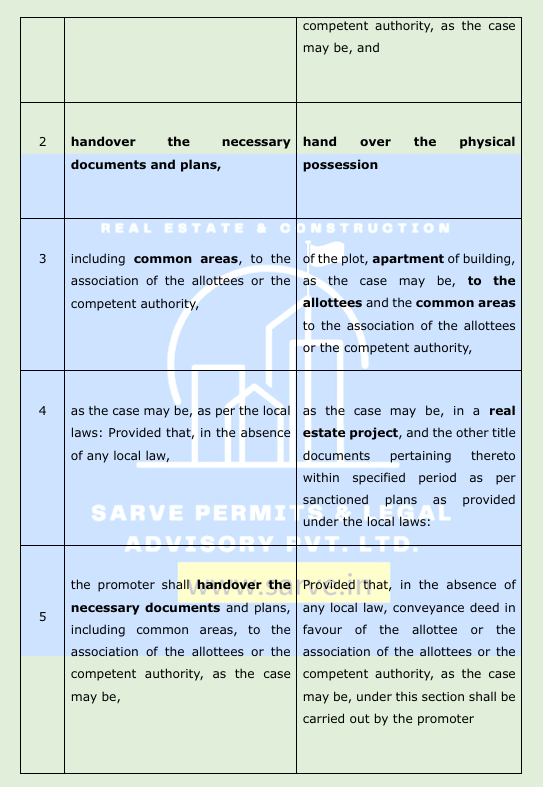
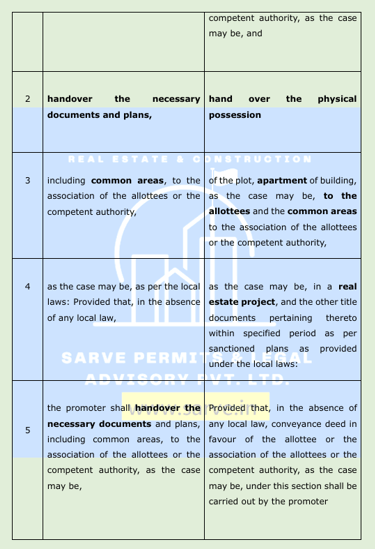
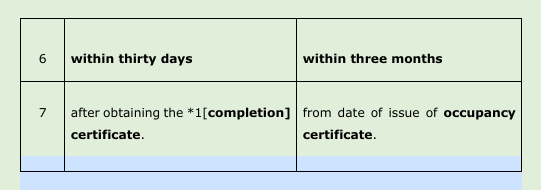
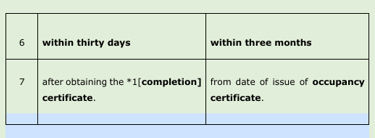
(1) The promoter shall execute a registered conveyance deed in favour of the allottee along with the undivided proportionate title in the common areas to the association of the allottees or the competent authority, as the case may be, and hand over the physical possession of the plot, apartment of building, as the case may be, to the allottees and the common areas to the association of the allottees or the competent authority, as the case may be, in a real estate project, and the other title documents pertaining thereto within specified period as per sanctioned plans as provided under the local laws: Provided that, in the absence of any local law, conveyance deed in favour of the allottee or the association of the allottees or the competent authority, as the case may be, under this section shall be carried out by the promoter within three months from date of issue of occupancy certificate.
(2) After obtaining the occupancy certificate and handing over physical possession to the allottees in terms of sub-section (1), it shall be the responsibility of the promoter to handover the necessary documents and plans, including common areas, to the association of the allottees or the competent authority, as the case may be, as per the local laws: Provided that, in the absence of any local law, the promoter shall handover the necessary documents and plans, including common areas, to the association of the allottees or the competent authority, as the case may be, within thirty days after obtaining the *1[completion] certificate.
[*1. Subs. by the Real Estate (Regulation and Development) Removal of Difficulties Order, 2016[S.O. 3347(E), for “occupancy” (w.e.f. 28-10-2016).]
Furthermore, the following sections of RERA Act provide complete clarity and clearly define the obligations, liabilities, functions, and responsibilities, for all concerned parties, including promoters and authorities.
Section 3(1)- 2nd paragraph- Provided that projects that are ongoing on the date of commencement of this Act and for which the completion certificate has not been issued,……………..
Section 3(2b)- Notwithstanding anything contained in sub-section (1), no registration of the real estate project shall be required—where the promoter has received completion certificate for a real estate project prior to commencement of this Act;
Section 4(2l)(C)- (l) a declaration, supported by an affidavit,…………(C) the time period within which he undertakes to complete the project or phase thereof, as the case may be;
Section 4(2l)(D)- (D) that seventy per cent. of the amounts realised for the real estate project from the allottees, from time to time, shall be deposited in a separate account to be maintained in a scheduled bank to cover the cost of construction and the land cost and shall be used only for that purpose: Provided that the promoter shall withdraw the amounts from the separate account, to cover the cost of the project, in proportion to the percentage of completion of the project:
………………………certified by an engineer, an architect and a chartered accountant in practice that the withdrawal is in proportion to the percentage of completion of the project:
………………………audited within six months…………duly certified and signed by such chartered accountant……………..percentage of completion of the project.
Section 5(3)- Grant of registration.— (3) The registration granted under this section shall be valid for a period declared by the promoter under sub-clause (C) of clause (l) of sub-section (2) of section 4 for completion of the project or phase thereof, as the case may be.
Section 11(4a)- (4) The promoter shall— (a) be responsible for all obligations, responsibilities and functions under the provisions of this Act or the rules and regulations made thereunder or to the allottees as per the agreement for sale, or to the association of allottees, as the case may be, till the conveyance of all the apartments, plots or buildings, as the case may be, to the allottees, or the common areas to the association of allottees or the competent authority, as the case may be:
Section 11(4b)- (b) be responsible to obtain the completion certificate or the occupancy certificate, or both, as applicable, from the relevant competent authority as per local laws or other laws for the time being in force and to make it available to the allottees individually or to the association of allottees, as the case may be;
Section 14(1)- (1) The proposed project shall be developed and completed by the promoter in accordance with the sanctioned plans, layout plans and specifications as approved by the competent authorities.
Section 15(2)- Obligations of promoter in case of transfer of a real estate project to a third party…..2nd paragraph….(2)………. Provided that any transfer or assignment permitted under provisions of this section shall not result in extension of time to the intending promoter to complete the real estate project and he shall be required to comply with all the pending obligations of the erstwhile promoter, and in case of default, such intending……………..
Section 16(2)- Obligations of promoter regarding insurance of real estate project…………………(2) The promoter shall be liable to pay the premium and charges in respect of the insurance specified in sub-section (1) and shall pay the same before transferring the insurance to the association of the allottees.
Section 16(3)- (3) The insurance as specified under sub-section (1) shall stand transferred to the benefit of the allottee or the association of allottees, as the case may be, at the time of promoter entering into an agreement for sale with the allottee.
Section 16(4)- (4) On formation of the association of the allottees, all documents relating to the insurance specified under sub-section (1) shall be handed over to the association of the allottees.
The Karnataka Town and Country Planning Act, 1961 in Section 17 provide us with better clarity on the completion certificate and the mandatory completion of works required for any layout development permission obtained by the promoter. The detail reference of the section are as following:
“Sanction of [Single Plot or Sub-division] of plot or Layout of private streets”:-
(1) The State Government shall by rules prescribe the standards to be followed and minimum extent of Land to be considered for approval of Layout for sub dividing a plot and prescribe the minimum extent of area to be earmarked for park, open spaces and civic amenity sites and laying out roads. Every person who intends to develop a single plot or sub divide his plot by making a layout on or after the date of the publication of the declaration of Local Planning Area under section 4-A, shall submit detailed plan of the layout of his plot showing layout of roads, sub-divided plots and earmarking area for park and open spaces and civic amenities to such extent and in such manner, as prescribed.
(2) The Planning Authority may, within the prescribed period, sanction such plan either without modification or subject to such modifications and conditions as it considers expedient or may refuse to give sanction, if the planning authority is of the opinion that such plan is not in any way consistent with the proposals of the Master Plan.
Provided that where the Master Plans are not finally approved, in such cases the Planning Authority may sanction the layout plan as per the guidelines issued by the Government from time to time.
(2A) If the Authority decides to sanction the layout plans under sub-section (2), it shall sanction provisional layout plan in accordance with such rules as may be prescribed for demarcation and development purposes showing the sites, street alignment, park and play ground and civic amenity area and any other infrastructure facility including the arrangement to be made for leveling, paving, metalling, flagging, channeling, sewering, draining, street lighting and water supply to the satisfaction of the Planning Authority and local authority. One copy of such plan shall be marked to the jurisdictional local authority. The owner shall relinquish the roads, parks and play ground to the local authority and Civic Amenity areas to the Planning Authority through registered relinquishment deed free of cost without claiming any compensation.
(2B) The Planning Authority shall ensure the completion of all development works including all infrastructure facilities as mentioned in sub-section (2A) under the supervision of the concerned Authority/ Agency/Department. On obtaining the certificate of completion from the concerned Authority/Agency/Department on having completed all the development works and on relinquishment of the roads, parks to the local authority and Civic Amenity areas to the Planning Authority and handing over the same, the Planning Authority may issue the final layout plan affixing the seal of the Planning Authority for registration purpose.
Provided that no Commencement Certificate or licence shall be sanctioned or issued for buildings on sites in the layout unless the final layout plan is issued.
(2-C) The Planning Authority, if a person so desires, may also permit the release of sites in two stages. In such a case, the Planning Authority on approval of the provisional layout plan release forty percent of the sites in the layout in the first stage and shall release the remaining sixty percent of the sites on completion of all development works in the following manner, namely:-
(i) On approval of the provisional layout plan in the prescribed manner before releasing forty percent of sites, the Planning Authority shall,-
(a) obtain the registered relinquishment deed, in the prescribed form, from the applicant to relinquish the areas reserved and demarcated for park, playground and the roads in the layout to the Local Authority and the area reserved and demarcated for civic amenities to the Planning Authority without claiming any compensation;
(b) shall also obtain the registered mortgage agreement of all the corner sites in the layout to the Planning Authority; and
(c) ensure that the project is registered under the Real Estate (Regulation and Development) Act, 2016 (Central Act 16 of 2016).
(ii) After obtaining above documents the planning Authority shall release forty percent of the sites scattered in the layout showing the building sites released affixing the seal of the Authority on the provisionally approved layout plan which shall be sent to the Local Authority for issue of khata of such sites for registration purpose under the Karnataka Stamps Act, 1957 (Karnataka Act 34 of 1957) and the Registration Act, 1908 (Central Act XVI of 1908).
(iii) The Planning Authority shall ensure the completion of all development works including all infrastructure facilities as specified under sub-section (2-A), on conducting inspection by the concerned Authority or Agency or Department within three years from the date of approval of the provisional layout plan. In case the completion certificates for completion of all development works are not obtained within three years from the date of approval of the provisional layout plan, the Planning Authority may for the reasons to be recorded extend the period for completion of development by a further period of one year.
(iv) On completion of all development works and obtaining the completion certificates within three years or within the extended period and obtaining the certificate of completion from the concerned Authority or Agency or Department including the development of the park, playground and civic amenity sites, the Planning Authority shall approve the final layout plan releasing the remaining sixty percent of the sites along with the corner sites mortgaged to the Authority. A copy of the finally approved layout plan, affixing the seal of the Planning Authority, showing the building sites released shall be sent to the Local Authority for issue of khata of such sites for registration purpose under the Karnataka Stamps Act, 1957 (Karnataka Act 34 of 1957) and the Registration Act, 1908 (Central Act XVI of 1908):
Provided that, in case the development works are not completed within the period specified under clause (iii), the corner sites mortgaged to the Planning Authority shall be forfeited to the Planning Authority.
(2-D). In case of layout provisionally approved under sub-section (2-B), the development works specified under sub-section (2-A) shall be completed within a period of three years from the date of approval of the provisional layout plan:
Provided that, the Planning Authority may, on application made in this behalf, for reasons to be recorded in writing, extend the period for development of the layout to such further period not extending one year, as it considers necessary. In case the development works are not completed within such specified period, the permission granted by the Planning Authority shall lapse. The applicant shall thereafter seek fresh approval following due procedure.
(2-E). Any building site which has not been released by the Planning Authority under this Act shall not be issued any Khata or given property index number (e-khata) under the Karnataka Municipalities Act, 1964 (Karnataka Act 22 of 1964), the Karnataka Municipal Corporations Act, 1976 (Karnataka Act 14 of 1976), the Karnataka Gram Swaraj and Panchayat Raj Act, 1993 (Karnataka Act 14 of 1993)or the Bruhat Bengaluru Mahanagara Palike Act, 2020 (Karnataka Act 53 of 2020) as the case may be.
(3) No compensation shall be payable for the refusal or the insertion, imposition or modification or conditions in the grant of sanction.
(4) If any person does any work in contravention of sub-section (1) or in contravention of the modifications and conditions of the sanction granted under sub-section (2) or despite refusal for the sanction under the said sub-section (2), the Planning Authority may direct such person by notice in writing to stop any work in progress and after making an inquiry in the prescribed manner, remove or pull down any work or restore the land to its original condition.
(5) Any expenses incurred by the Planning Authority under sub-section (4) shall be a sum due to the Planning Authority under this Act from the person in default.
(6) Any person aggrieved by the decision of the Planning Authority under sub-section (2) or sub-section (4) may, within thirty days from the date of such decision appeal to such authority as may be prescribed.
(7) The prescribed authority may after giving a reasonable opportunity of being heard to the appellant and the Planning Authority, pass such order as it deems fit, as far as may be, within four months from the date of receipt of the appeal.
The Karnataka Municipalities Model Building By-Laws, 2017 was published by URBAN DEVELOPMENT URBAN DEVELOPMENT SECRETARIAT NOTIFICATIONII No. UDD 14 TTP TTP 2017 (P4), Bengaluru, Dated: 28/10/2017.
Definitions to be noted as per the Karnataka Building By-Laws, 2017.
‘Conversion of Occupancy’ means the change from one occupancy to other occupancy or any change in building structure or part thereof resulting in a change of space and use requiring additional occupancy certificate.
‘Empanelled Professional’ means professionals such as Architects, Engineers, Structural consultants, MEP consultants, Environment consultants etc., who are empanelled by the Authority as per the provisions of these byelaws as authorised persons to inspect the plots before, during, and after construction, as the case may be, to certify the constructions made as per the provisions of the approved plans and report to the Authority and also to sanction building plans of certain buildings as notified by the government.
95. “Licensed Professional’’ means Qualified professionals who have been registered with the Urban Local Body as per the Qualification and competence notified by the Government and therefore possess the license to provide professional services in Building construction. Only licensed professionals would be allowed to be professionals on record.
106. “Occupancy or use” means the principal occupancy or use for which a building or a part of a building is intended to be used. For the purposes of classification of a building according to occupancy, occupancy shall be deemed to include the subsidiary occupancies which are contingent upon it.
“Mixed occupancy” buildings being those in which more than one occupancy is present in different portions of the buildings.
144. “Site Plan” means a detailed Plan showing the proposed placement of structures, parking areas, open space, landscaping, and other development features, on the plot as required by specific sections of these Bye laws.
159. “Zonal Regulations” means the regulations of the Master Plan governing land use and developments.
In reference to Building By-Laws-2017 state as follows;
Clause: 3.17 Completion of project and issuing Completion Certificate
3.17.1 Issuing completion certificate
(1) On completion of all works at site that have been certified by the empanelled professionals as specified in Appendix-XII, as per the specifications and other provisions of these Byelaws, the principal professional on record for supervising the works(for supervising the major civil works), shall issue Completion Certificate in Form-XIII, endorsed by all other concerned professionals on record for supervising various components of the building along with the certification of Structural design and safety in Form-XV;
(2) In case of independent residential houses and Industrial buildings, the Professional on record shall issue work completion certificate only if all the works within the building and the yard are completed and the same is certified by the empanelled professionals;
(3) In case of other residential and non-residential buildings, the Professional on record shall issue work completion certificate only if all the works are completed in the common areas of the building, the exterior of the building and services to be provided in the apartments, commercial and other premises of the building are also completed and certified by the Empanelled professional:
Provided that, in case of partial completion of the building, partial work completion certificate may be issued by the professional on record for the number of floors (starting from the lowermost floor moving upwards) upto which all works of the common areas and exterior of the building are completed and services to be provided in the apartments, commercial and other premises of those floors of the building are also completed.
3.17.2 Application for approval of works from other departments
(1) The professional on record for preparing drawings and details for all the applicable NOCs from other departments, for the project, shall submit the required applications in Form-II (any or all of a, b, c, d, e, f, g, h, i and j, as applicable), for approvals from other departments for the construction done at site as per the NOCs issued;
(2) On receiving the work Completion Certificate and the application to various departments for approving the works executed at sites as per the NOCs issued, the Authority shall intimate all the concerned departments which have issued NOCs, along with the certification done by the empanelled professional, for issuing the prescribed certificate of approval for the construction done at site, wherever applicable;
(3) On receiving the intimation from the Authority, the concerned departments which had issued NOCs, shall issue the required certificates of approval for the construction done at site, wherever applicable, with or without site inspection;
(4) During the site inspection, according to the designated officer of the concerned department, if any of the works executed at site is not as per the conditions/specifications of the NOC issued, he shall issue endorsement through the Authority, to the applicant, along with the photographs of the defective works, to rectify the defects;
(5) On receiving the endorsement from such departments through the Authority, the applicant shall rectify the defects and intimate the concerned department;
(6) According to the Applicant or the concerned professional on record for supervision of work (for which endorsement is received from the concerned department), if the defects mentioned in the endorsement is incorrect, the Applicant may file objection, to the concerned department and the Authority, stating the correctness of the works executed, along with the photos to prove the correctness, if required;
(7) If objection is received from the Applicant, the CEO of the Authority shall conduct joint inspection along with the Applicant, the concerned professional on record, the Empanelled professional who has certified the work and the designated officer of the concerned Department who has issued the endorsement for defective work, by giving notice to all, to conduct joint inspection within seven days of receiving objection;
(8) During the joint inspection, the CEO of the Authority, after hearing the views of both the parties, shall either accept or reject the objection raised by the applicant and instruct the Applicant accordingly after making his inspection report in Form-XII (copy of the same to be sent to the designated officer of the concerned department) and the decision of the CEO shall be final. The Applicant shall abide by the decision of the Authority and rectify the defects mentioned in Form-XII, if any and intimate the Authority;
(9) On receiving the intimation of defect rectification by the Applicant, the Authority shall inform the Empanelled professional to inspect and certify the rectified work;
(10) The Empanelled professional shall inspect the site and after checking the work rectified as indicated in Form-XII, certify the same in Form-X within three days of receiving intimation; and
(11) The Authority shall forward the certification issued in Form-X by the empanelled professional, to the concerned department and the concerned shall issue the required certificate of approval for the construction done at site, with or without site inspection.
3.18 Occupancy Certificate.
On receiving the completion certificate in Form-XIII and certificates of approval from the concerned departments or as certified by the Authority as specified in Clause 3.17.2 (8), (9) and (11), the Authority shall issue Occupancy Certificate in Form-XIV to the building constructed as per these Byelaws.
3.18.1 Occupancy or letting of the new buildings.
No person shall occupy or allow any other person to occupy any new building or part of a new building for any purpose whatsoever until Occupancy Certificate to such buildings or part thereof has been granted
3.18.2 Occupancy/ Part Occupancy Certificate for Phased Project.
In such cases where a project has not been completed at one stretch but constructed in different stages, part occupancy certificate for the building otherwise complete in all respects, may be issued subject to the condition that;
(a) part work completion certificate is issued by the professional of record as specified in clause 3.17.1; and
(b) The remaining construction of the building is completed within the validity period or the extended validity period.
3.19 Connection to the municipal sewer / water mains and power supply system of the concerned Escom
(1) Temporary connection for water, electricity or sewer, permitted for the purpose of facilitating the construction, shall not be allowed to continue in the premises without obtaining occupancy certificate;
(2) No new connection to the Municipal water mains or to the Municipal sewer line with a building shall be made without obtaining occupancy certificate and any existing connection provided for construction shall be disconnected if the building is occupied without Occupancy Certificate;
(3) Permanent power supply to the building shall also not be provided to any new building unless the building has received Occupancy Certificate / Part Occupancy Certificate; and
(4) In case the use is changed or unauthorized construction is made, the Authority is authorized to discontinue such services or cause discontinuance of such services.
4. DEVELOPMENT REGULATIONS.
The provisions contained in Master Plan/Zonal Regulations shall apply and where these are silent on such issues or which require interpretation the norms as decidedly the Authority, shall apply. The provisions include but are not limited to the use/activity of premises, ground coverage, FAR, setbacks, open space, height and parking standards for Residential premises on plotted development, Group housing, Resettlement colonies, Slums, In situ up gradation, Non-residential premises. The permission of uses/use activities in use premises shall be permitted in accordance with provisions of Master Plan and Zonal Regulations. The object of these regulations is to provide control for building/buildings within use premises excluding the internal arrangement, which is covered and controlled by Building Bye-Laws.
In conclusion, would strongly and respectfully request that to re-consider decision and discuss the above subject with a larger forum. Clarity in compliance, especially in the real estate industry, is essential. The essence of the RERA Act should be embraced in the right spirit, ensuring equity and justice in an efficient and transparent manner.
On the other hand, the promoters are more focused on making profits and cutting corners, rather than prioritizing safety, quality, transparency, or compliance with the RERA Act. They concentrate on generating revenue and increasing the number of projects, aiming to become market leaders in the real estate industry. Meanwhile, they force allottees and customers to run from pillar to post by misusing legal processes and taking advantage of their lack of awareness and knowledge of real estate laws.
It is important to be inspired by countries like Dubai, which are implementing RERA laws internationally and in other hand, Indian State RERA Authorities that serve homebuyers in their regions. These efforts directly or indirectly help all stakeholders, partners, investors, and FDI in the real estate industry by streamlining processes and improving clarity, making it easier to do business and enhancing the ease of living for homebuyers.
Implementing uniformity in the issuance of Completion and Occupation Certificates poses significant risks. Such a move could undermine transparency and procedural clarity, potentially dragging millions of homebuyers and real estate investors into legal disputes yearly. It may also allow promoters to exploit loopholes, leaving projects incomplete without accountability. The resulting statutory and regulatory uniformity could severely impact the real estate market, leading to a surge in complaints filed for litigation at all level of courts in local, states & centre. This would damage public perception, tarnish Karnataka’s real estate reputation, and create widespread disruption across the sector.
Therefore, it is crucial not to conflate these two certificates; each plays a unique role at different stages of a project’s lifecycle as mandated by various local, state, and central regulations.
Thanking you Sincerely yours,
Advocate Rajeev K Jha
Email: sarvadvisory@gmail.com
completion certificate, occupancy certificate, difference between completion and occupancy certificate, completion certificate vs occupancy certificate, RERA certificate requirements, RERA compliance certificates, comparison of completion and occupancy certificate, legal documents for property possession, property handover certificates, RERA guidelines for completion certificate, RERA guidelines for occupancy certificate, real estate certification process, home buyer certificates in India, importance of completion certificate, importance of occupancy certificate, building approval certificates, real estate documentation under RERA
What is a completion certificate as per RERA?
What is an occupancy certificate as per RERA?
What is the difference between a completion certificate and an occupancy certificate?
Why are both completion and occupancy certificates important in real estate?
When is a completion certificate issued according to RERA guidelines?
When does a builder obtain an occupancy certificate under RERA?
Can you take possession without an occupancy certificate?
Who issues the completion and occupancy certificates under RERA?
Is it mandatory to have both certificates for property registration?
What are the legal implications of lacking an occupancy or completion certificate in India?
How do the requirements for these certificates differ from state to state in India?
How does RERA protect home buyers regarding these certificates?
North India - Delhi NCR
UTTAR PRADESH : B-122, Sector-Omicron-1A, Greater Noida, Gautam Budh Nagar, Uttar Pradesh, India - 201310
Hours
I-V 9:00-18:00
VI - VII Closed


Copyright
We have @SarvePermits & Legal Advisory Pvt Ltd's original, exclusive and copyright protected content for you. Don't miss out on the opportunity and get access to our informative content today! #CopyrightProtected #OriginalContent #SarvePermitsAndLegal. If you have any questions about using our content, please contact us for permission. #copyright #protectourproperty #IP #SarvePermitsAndLegalAdvisoryPrivateLimited.
Western India - Maharashtra
MUMBAI : Office No.- 1408, Ghanshyam Enclave, Opp. Lalji Pada Police Station, Link Road, Kandivali West, Mumbai
South India - Karnataka
BANGALORE : B-2, Ground Floor, Museum Terrace, 29 Museum Road, Bangalore-560001
RESIDENCE : 50808, Tower 5, Bhartiya City Nikoo Homes 1, Thanisandra Road, Kannur, Bangalore - 560064
Eastern India - Jharkhand
BOKARO : 689, Sector-1/C, Bokaro Steel City, Dist.- Bokaro, Jharkhand -827001